 English
 Russian
 French
 Spanish
 Portuguese
 Arabic
 Vietnamese
 Turkish

Alloy
A high-tech enterprise focusing on the development and application of X-ray technology products, committed to becoming a leading supplier of X-ray industrial testing solutions.
Handheld vs. Benchtop XRF Spectrometers: A Guide for Lab and Field Use
X-ray fluorescence (XRF) spectrometry has become an indispensable tool for rapid, non-destructive elemental analysis across a vast array of industries. From scrap metal recycling and mining exploration to pharmaceutical quality control and academic research, the ability to identify material composition is critical.
However, for organizations looking to invest in this technology, a fundamental question arises: Should you choose a portable, rugged handheld analyzer or a powerful, stationary benchtop system?
The Core Philosophy: Mobility vs. Maximum Performance
At its heart, the choice between handheld and benchtop XRF revolves around a classic trade-off. A portable XRF is your "go-anywhere scout"—a versatile tool designed for rapid screening and on-site decision-making. A benchtop XRF, by contrast, is your "dedicated laboratory expert"—a high-precision instrument optimized for the most accurate and detailed quantitative analysis.
Let's explore what each type brings to the table.

Handheld XRF Analyzers: The Power of the Field
Handheld XRF analyzers are compact, battery-powered devices engineered to bring the lab to the sample. Their defining feature is portability.
Advantages
Unmatched Portability and Speed: These devices can be carried anywhere—from a scrapyard to a remote mine site. They provide results in seconds, enabling immediate, real-time decisions.
Minimal to No Sample Preparation: In most screening applications, you can simply point the analyzer at the material and pull the trigger. There is no need to cut, grind, or homogenize the sample, saving significant time and effort.
Ease of Use: Handheld analyzers are designed with user-friendly interfaces and require minimal training, allowing non-specialists to operate them effectively.
Versatility: A single device can be used for a multitude of tasks, such as sorting scrap metal, verifying alloy pipes (Positive Material Identification or PMI), screening soil for contaminants, and even analyzing art and archaeology artifacts in situ.
Limitations
Lower Sensitivity and Precision: Due to their small size and lower-power X-ray tubes, handhelds generally have higher detection limits and are less precise than benchtop systems. They are excellent for identification and screening but may lack the accuracy needed for trace-level quantification.
Surface-Level Analysis: The analysis is limited to the sample's surface (typically a few microns to millimeters deep). It can be less effective on non-uniform or layered materials without specific calibrations.
Best Use Cases
Scrap Metal Recycling: Rapid sorting and identification of alloys for accurate pricing and efficient processing.
Mining & Exploration: On-site ore grade control, geochemical mapping, and guiding drilling decisions.
Positive Material Identification (PMI): Verifying the composition of pipelines, valves, and structural components in refineries, chemical plants, and construction sites to ensure safety and compliance.
Environmental Screening: Quick assessment of soil, sediment, and waste for heavy metal contamination like lead, arsenic, and cadmium.
Consumer Goods & Regulatory Compliance: Screening electronics and plastics for restricted substances (e.g., RoHS compliance).
Benchtop XRF Analyzers: The Laboratory Standard
Benchtop XRF spectrometers are stationary instruments designed for controlled environments like laboratories and quality control centers. They sacrifice mobility for maximum analytical power.
Advantages
Superior Accuracy, Precision, and Sensitivity: With higher-power X-ray tubes, optimized optics, and advanced detectors, benchtop systems deliver exceptional analytical performance.
Advanced Sample Versatility: They can handle a wide variety of sample forms, including solids, powders, pressed pellets, fused beads, liquids, and thin films. Automated sample changers allow for high-throughput, walk-away analysis of dozens of samples.
Limitations
Lack of Portability: These systems require a stable power supply, a clean, vibration-free bench, and often climate control. They cannot be taken into the field.
Sample Preparation Required: To achieve the highest accuracy, samples often need to be prepared—ground into a powder, pressed into a pellet, or fused into a glass bead. This adds time and requires additional equipment.
Best Use Cases
Quality Control/Quality Assurance (QC/QA) in Manufacturing: Precise compositional analysis of cements, metals, polymers, and glass to ensure product specifications are met.
Geochemical and Mining Laboratories: High-accuracy quantification of major, minor, and trace elements in prepared rock, soil, and ore samples for resource evaluation and research.
Cement and Petrochemical Industries: Routine analysis of raw materials, clinker, cement, and sulfur in fuels/oils where exact composition is mission-critical.
Academic and Research Institutions: Detailed material characterization and elemental studies across physics, chemistry, archaeology, and materials science.
Regulatory and Forensic Testing: Definitively measuring restricted substances in consumer products (RoHS, REACH) or identifying trace evidence for legal cases.
The EulerX 900S series handheld analyzer delivers fast, accurate, non-destructive results across alloy identification, quality control, scrap recycling, precious metals, and PMI. Its advanced electronics provide laboratory-quality measurements in seconds with minimal training and no sample preparation, regardless of sample shape or size.
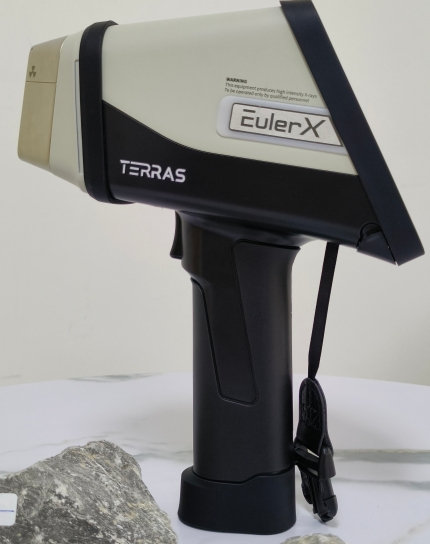
Terras EulerX900S Handheld Alloy Analyzer
Conclusion: There is No Single "Best" Answer
The decision between a handheld and a benchtop XRF spectrometer is not about finding a winner, but about finding the right fit. If your world is the scrapyard, the mine face, or the refinery pipe, the rugged independence of a handheld analyzer is invaluable. If your world is the laboratory, where precision, throughput, and trace-level detection are paramount, the benchtop system is an unmatched workhorse.
About Terra Scientific
Terra Scientific is a high-tech manufacturer specializing in the development and application of X-ray technology products. We are committed to becoming a world-class provider of X-ray industrial inspection solutions. Terra Scientific currently offers a range of products to global customers, including handheld alloy analyzer, handheld precious metal analyzer, handheld mining analyzer, benchtop precious metal analyzers, in-line analyzer, and spectrometer modules, along with XRF analyzers. We continuously serve global clients in fields such as mechanical manufacturing, metal processing, aerospace, petrochemicals, mining and geology, food safety, environmental protection, and scientific research.
To learn more, please don't hesitate to contact us via email at sales@terra-scientific.com, or visit our website at http://www.terra-scientific.com
Join Us
Subscribe to our email list for updates & promotions.