 English
 Russian
 French
 Spanish
 Portuguese
 Arabic
 Vietnamese
 Turkish
Gold and Jewelry
A high-tech enterprise focusing on the development and application of X-ray technology products, committed to becoming a leading supplier of X-ray industrial testing solutions.
XRF Precious Metal Analyzer Price: What Factors Really Drive the Cost
If you're in the business of buying, selling, refining, or manufacturing precious metals, you've undoubtedly heard of XRF (X-Ray Fluorescence) analyzers. These remarkable devices are the industry standard for providing fast, non-destructive, and accurate elemental analysis. But when you start shopping for one, you'll quickly find a wide range of prices—from the cost of a used car to that of a small house.
So, what exactly are you paying for? Is the most expensive model always the best? And can a cheaper one truly meet your needs?
The truth is, the price tag isn't arbitrary. It's driven by a combination of performance, features, and intended use. Let's break down the key factors that determine the cost of an XRF precious metal analyzer.

1. Detector Type: The Heart of the Machine
This is arguably the single biggest factor influencing performance and price.
SDD (Silicon Drift Detector): This is the modern, high-performance standard. SDD detectors offer incredibly fast analysis times (often 2-5 seconds) and excellent resolution for accurately distinguishing between closely spaced elements (like Rhodium, Palladium, and Silver). If you need high throughput, precise karat measurement, or the ability to detect light elements, an SDD is essential. This technology comes at a premium.
Si-PIN (Silicon Pin Diode Detector): Older and more affordable, Si-PIN detectors are slower and have lower resolution. They can struggle with complex alloys or accurately measuring light elements. For a business that only needs to verify 24k gold or pure silver, a Si-PIN model might suffice. However, for most professional applications, the limitations outweigh the initial cost savings.
Bottom Line: If your business depends on speed and accuracy, invest in an SDD detector. It's the core of what you're paying for.
2. X-Ray Tube Technology: The Power Source
The tube generates the X-rays that excite the sample. Its characteristics directly impact what you can analyze.
Power (Wattage): Higher wattage tubes (e.g., 40W or 50W) provide greater excitation, leading to faster analysis and better performance for challenging samples like heavy concentrates or high-karat platinum.
Voltage (kV) and Anode Material: A higher maximum voltage allows the analyzer to excite a wider range of elements, including heavier ones. Tubes with different anode materials (like Rhodium or Tungsten) are optimized for specific element ranges. A more versatile and powerful tube increases the cost.
3. Analytical Range and Light Element Performance
What do you need to analyze?
Precious Metals Only: If you only need to measure classic precious metals (Au, Ag, Pt, Pd, Rh, Ru), you can opt for a more basic configuration.
Light Elements (Mg, Al, Si, P, S): This is a major price differentiator. Analyzing light elements is crucial for:
Karat Gold: Accurately measuring the copper and silver content.
Mining & Geochemistry: Analyzing ore grades.
Identifying Plated Items: Detecting the base metal underneath a thin plating (e.g., spotting a tungsten core in a gold-plated bar).
The hardware and software required to reliably detect light elements are more advanced, significantly adding to the cost.
4. Form Factor: Handheld vs. Benchtop
Handheld (HHXRF): Offers ultimate portability for on-the-spot analysis at a pawn shop, scrap yard, or mining site. You pay a premium for miniaturization, battery power, and ruggedness. Prices can range significantly based on the other factors listed here.
Benchtop: Generally offers the highest performance, stability, and safety for lab-like environments (refineries, quality control labs). They often feature more powerful tubes, larger samples chambers, and helium purge systems for superior light element analysis. While sometimes cheaper than top-tier handhelds, high-performance benchtop models are a significant investment.
5. Software and Calibrations
The hardware is nothing without the brains to interpret the data.
Pre-Loaded Calibrations: Professional-grade analyzers come with sophisticated, factory-developed calibrations for specific applications (e.g., karat gold, bullion, platinum jewelry, mining ores). Developing these requires extensive R&D.
User Calibration Capability: The ability to create your own custom calibrations for unique alloys is a feature of more advanced (and costly) systems.
Data Management and Connectivity: Software that offers robust data logging, report generation, cloud connectivity, and integration with scales/printers adds value and cost.
6. Brand, Support, and Certification
Manufacturer Reputation: Established brands with a long history of innovation and reliability often command higher prices, reflecting their investment in quality control and continuous improvement.
Service and Support: This is critical. The price includes (or should include) access to expert technical support, comprehensive training, and readily available repair services. A cheaper analyzer from a company with poor support can become a very expensive paperweight.
Regulatory Compliance: Ensuring the analyzer meets global safety and regulatory standards (like FDA, CE, and RoHS) involves costly certification processes.
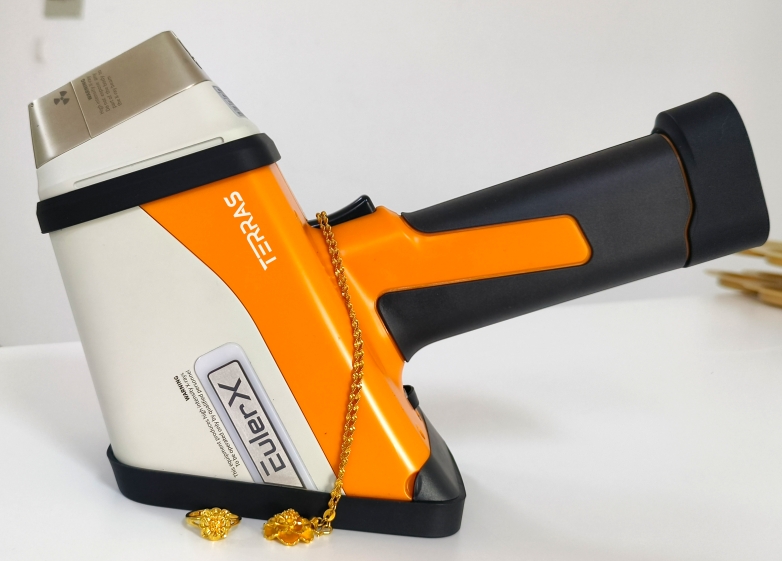
Terras EulerX990 Handheld Precious Metal Analyzer
Final Takeaway
The price of an XRF precious metal analyzer is a direct reflection of its capabilities, accuracy, and the support behind it. By understanding the factors that drive the cost—detector type, tube power, analytical range, and form factor—you can move beyond sticker shock and make a strategic investment.
The EulerX990 Portable Gold Analyzer brings definitive, laboratory-grade precision to the point of need. It utilizes advanced XRF technology to deliver immediate and precise composition data for precious metals—including gold (9-24K), silver, platinum, and palladium—while expertly identifying plated items and irregular mixtures. Engineered for durability in harsh conditions, its rugged portability and intuitive interface serve professionals in jewelry, pawn, and mining. Integrated connectivity (Wi-Fi/USB) ensures seamless data export for comprehensive analysis and secure audit trails.
The goal is not to find the cheapest analyzer, but to find the one that provides the best value by solving your specific analytical challenges, saving you time, preventing costly mistakes, and building trust with your customers.
About Terra Scientific
Terra Scientific is a high-tech manufacturer specializing in the development and application of X-ray technology products. We are committed to becoming a world-class provider of X-ray industrial inspection solutions. Terra Scientific currently offers a range of products to global customers, including handheld alloy analyzer, handheld precious metal analyzer, handheld mining analyzer, benchtop precious metal analyzers, in-line analyzer, and spectrometer modules, along with XRF analyzers. We continuously serve global clients in fields such as mechanical manufacturing, metal processing, aerospace, petrochemicals, mining and geology, food safety, environmental protection, and scientific research.
To learn more, please don't hesitate to contact us via email at sales@terra-scientific.com, or visit our website at http://www.terra-scientific.com
Join Us
Subscribe to our email list for updates & promotions.