 English
 Russian
 French
 Spanish
 Portuguese
 Arabic
 Vietnamese
 Turkish

soil
A high-tech enterprise focusing on the development and application of X-ray technology products, committed to becoming a leading supplier of X-ray industrial testing solutions.
A Beginner's Guide to Understanding and Using EDXRF Spectrometers
Have you ever wondered how scientists can tell you exactly what an ancient coin is made of, or how a mining company knows the precise composition of an ore sample in seconds? Often, the answer lies in a powerful yet increasingly accessible tool: the EDXRF Spectrometer.
If terms like "energy-dispersive X-ray fluorescence" sound intimidating, don't worry. This guide will break down what EDXRF is, how it works, and how you can start using this fascinating technology.
What is EDXRF, Anyway?
Let’s start with the acronym: EDXRF stands for Energy-Dispersive X-Ray Fluorescence.
X-Ray Fluorescence (XRF): This is the core phenomenon. When a material is hit with high-energy X-rays, its atoms get excited and emit their own, characteristic "fluorescent" X-rays. It's like each element (iron, copper, gold, etc.) sings its own unique note when energized.
Energy-Dispersive (ED): This is how we "listen" to that song. The spectrometer uses a special detector to measure the energy of those emitted X-rays. Since each element's "note" has a specific energy, the device can identify which elements are present and in what quantities.
In short, an EDXRF spectrometer is an instrument that shoots X-rays at a sample and then analyzes the returning energy signature to determine its elemental makeup—all without destroying the sample.

How Does an EDXRF Spectrometer Work? (The Simple Version)
Imagine it as a three-step process:
Excitation: The instrument fires a beam of primary X-rays from a tiny, controlled X-ray tube at your sample.
Emission: The atoms in the sample absorb this energy and become unstable. To return to a stable state, they emit secondary X-rays unique to each element present.
Detection & Analysis: A sophisticated silicon-based detector (like an SDD – Silicon Drift Detector) captures these secondary X-rays. A connected computer then processes the energy data, producing a spectrum—a graph with peaks at specific energy levels. Each peak corresponds to an element, and its height indicates the approximate concentration.
The entire process takes seconds to a few minutes.
What Can You Use EDXRF For?
The applications are incredibly diverse:
Metals Analysis: Identifying alloy grades, checking for lead in consumer goods (RoHS compliance), and quality control in manufacturing.
Mining & Geology: On-site analysis of ore grades, core samples, and soil surveys.
Environmental Science: Screening for toxic heavy metals (like lead, arsenic, cadmium) in soil, sediment, or filters.
Art & Archaeology: Authenticating artifacts, analyzing pigments in paintings, and conserving historical objects non-destructively.
Consumer Safety: Ensuring toys, jewelry, and cosmetics are free from hazardous elements.
A Quick Guide to Getting Started with EDXRF
Ready to try it? Here’s a basic roadmap:
1. Know Your Sample:
Size & Shape: EDXRF works best on flat, homogeneous surfaces. Irregular shapes can affect accuracy.
Preparation: While "non-destructive" is a key feature, preparation helps. For loose materials (soil, powders, chips), compressing them into a pellet creates a smooth, consistent surface. Liquids can be analyzed in special cups.
2. Choose Your "Mode":
Most modern EDXRF spectrometers offer different analysis modes optimized for certain elements or sample types.
Soil Mode: Optimized for lighter elements common in environmental samples.
Alloy Mode: Tailored for metals, with pre-loaded libraries of common alloys (e.g., stainless steel 304, brass C360).
Plastics Mode: Configured to detect additives and restricted elements in polymers.
Your instrument's software will guide you to the best choice.
3. The Measurement Process:
Place the sample in or against the measurement window.
Select the appropriate mode/test on the touchscreen or software.
Initiate the analysis. You'll hear a gentle whirr or see a countdown timer.
In seconds, your results will appear on the screen—often as a list of elements with percentages or parts-per-million (ppm) concentrations, and sometimes with a likely alloy match.
4. Understanding Your Results:
Don't just look at the numbers; look at the spectrum. The software will show the graph with labeled peaks. This visual confirmation helps you trust the result. Is there a big peak for Iron (Fe) and Chromium (Cr)? You're likely looking at stainless steel.
Important Considerations for Beginners
It’s a Surface Technique: EDXRF analyzes only the top few micrometers to millimeters of a sample. A gold-plated lead object will read as gold on the surface.
Safety First: While the X-ray beam is fully shielded and operators are safe, never tamper with the safety interlocks or point the window at yourself or others. Modern devices have multiple safety features to prevent accidental exposure.
Calibration is Key: For precise quantitative results (exact percentages), you must calibrate the instrument using certified reference materials (CRMs) that are similar to your samples.
Heavy metals like cadmium, mercury, and lead can persist in soil for decades, posing long-term risks. Using the EulerX 600 Handheld Soil Analyzer for on-site XRF screening enables rapid detection, reduces laboratory testing needs, cuts costs and time, and helps target remediation efforts by quickly mapping contaminated zones.
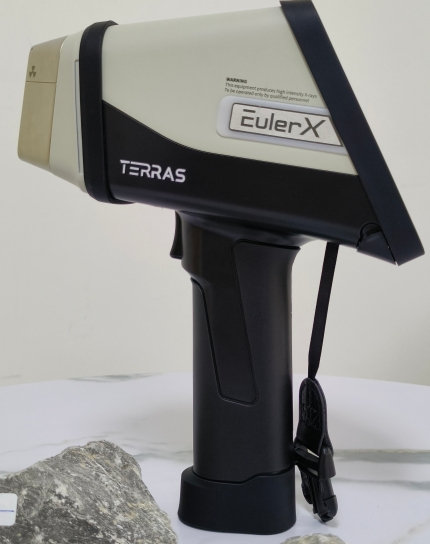
Terras EulerX600 Handheld Soil Analyzer
The Bottom Line
EDXRF spectrometers have moved from bulky lab machines to portable, user-friendly tools that deliver lab-quality results anywhere. They empower geologists in the field, quality inspectors on the factory floor, and conservators in the museum vault with immediate elemental answers.
By understanding the basic principle of exciting atoms and reading their fluorescent "signature," you can unlock a powerful way to see the hidden composition of the world around you. Start with simple, known samples to build confidence, and you'll soon be leveraging this remarkable technology like a pro.
About Terra Scientific
Terra Scientific is a high-tech manufacturer specializing in the development and application of X-ray technology products. We are committed to becoming a world-class provider of X-ray industrial inspection solutions. Terra Scientific currently offers a range of products to global customers, including handheld alloy analyzer, handheld precious metal analyzer, handheld mining analyzer, benchtop precious metal analyzers, in-line analyzer, and spectrometer modules, along with XRF analyzers. We continuously serve global clients in fields such as mechanical manufacturing, metal processing, aerospace, petrochemicals, mining and geology, food safety, environmental protection, and scientific research.
To learn more, please don't hesitate to contact us via email at sales@terra-scientific.com, or visit our website at http://www.terra-scientific.com
Join Us
Subscribe to our email list for updates & promotions.