 English
 Russian
 French
 Spanish
 Portuguese
 Arabic
 Vietnamese
 Turkish

soil
A high-tech enterprise focusing on the development and application of X-ray technology products, committed to becoming a leading supplier of X-ray industrial testing solutions.
Lab Analysis vs. Portable XRF: Choosing the Right Soil Testing Tool for Your Project
When you need to test soil, whether for assessing a brownfield site, optimizing farmland, or investigating potential contamination, the quality of your data will determine your project's success. Today, professionals face a critical choice: traditional laboratory analysis or on-site portable X-ray fluorescence (XRF) testing. This is often framed as a direct competition, but a smarter approach is to see them as complementary tools in your investigative arsenal.
Let’s break down the strengths, limitations, and ideal applications of each to help you make an informed decision.
Portable XRF: The Power of Immediate Insight
Imagine knowing the elemental composition of your soil right where it lies in a matter of seconds. That is the revolutionary promise of portable XRF.
The Core Advantage: Speed & Density
The single greatest benefit is real-time, on-site analysis. You can take hundreds of readings in one day, generating high-resolution maps of metal contaminants (like lead, arsenic, chromium, copper) or key nutrients. This enables:
Instant Decision-Making: Identify hotspots immediately, adjust your sampling strategy on the fly, and make critical field decisions without waiting weeks for results.
High-Density Mapping: Reveal contamination gradients and plumes that a limited number of discrete lab samples might miss entirely.
Significant Screening Cost Savings: Drastically reduce the number of samples you need to send to the lab by using the XRF to triage and identify the most representative or critical samples.
Key Considerations:
It's a Screening Tool: Portable XRF is recognized by agencies like the EPA as a powerful screening tool. It provides highly accurate relative data—perfect for comparing Site A to Site B or tracking trends across a field.
"Near-Lab" Quality is Possible: With proper sample preparation (drying, homogenizing, milling), field data can approach laboratory quality for many elements. Without prep, you're analyzing in-situ conditions, which is valuable but different.
Detection Limits: While excellent for heavy metals, it may not detect trace elements at very low (parts-per-billion) concentrations as effectively as lab methods.
Matrix Effects: Soil moisture, organic content, and particle size can influence readings, highlighting the need for proper technique and calibration.
Best For: Rapid site characterization, delineating contamination boundaries, real-time excavation guidance, large-scale agricultural surveys, and intelligently selecting samples for laboratory submission.

Laboratory Analysis: The Gold Standard of Precision
When you require legally defensible, highly precise data with ultra-low detection limits, traditional laboratory analysis remains indispensable.
The Core Advantage: Unmatched Accuracy & Defensibility
Labs utilize techniques like ICP-MS (Inductively Coupled Plasma Mass Spectrometry) or ICP-OES. These offer:
Extremely Low Detection Limits: Capable of measuring elements in the parts-per-billion (ppb) range, which is crucial for regulated compounds and sensitive baseline studies.
Unquestionable Data Quality: Analyses are performed in accredited labs (e.g., NELAP, ISO 17025) under strict QA/QC protocols, producing legally defensible data for regulatory submissions, compliance reports, and litigation.
A Broader Analytical Suite: Labs can test for much more than just elements. They analyze volatile organic compounds (VOCs), pesticides, PCBs, PFAS, pH, and cation exchange capacity (CEC)—parameters that an XRF cannot detect.
Key Considerations:
Time Lag: Turnaround times range from days to several weeks, potentially halting field progress while awaiting results.
Higher Cost Per Data Point: Each sample sent to the lab incurs a direct cost, which limits the total number you can practically analyze, potentially reducing spatial understanding.
"Blind" Sampling: You must commit to a sampling plan with limited prior knowledge, risking the chance of missing critical areas between sample points.
Best For: Final compliance and regulatory reporting, establishing definitive baseline conditions, detecting trace-level contaminants, analyzing for non-metal parameters (VOCs, etc.), and any situation where data will face legal or rigorous scientific scrutiny.
Making the Choice: A Quick Guide
Choose Portable XRF when your priority is speed, spatial understanding, and cost-effective screening. It is ideal for initial site assessments, dynamic field guidance, and mapping large areas.
Choose Laboratory Analysis when your need is for ultimate precision, regulatory acceptance, or analyzing parameters beyond metals. It is essential for final reporting, detecting trace organics, and legally definitive results.
Embrace the Hybrid Approach for complex, large-scale, or regulated projects. Use XRF to ask better questions of the site, and the lab to provide the definitive, gold-standard answers.
Heavy metals such as cadmium, mercury, lead, and chromium can persist in soil for years, originating from industrial, agricultural, or waste disposal activities. The EulerX 600 Handheld Soil Analyzer offers an efficient, on-site XRF screening solution, detecting contaminants within seconds. This significantly reduces laboratory samples, lowers analysis costs and time, and helps minimize remediation expenses by rapidly identifying and mapping contaminated areas.
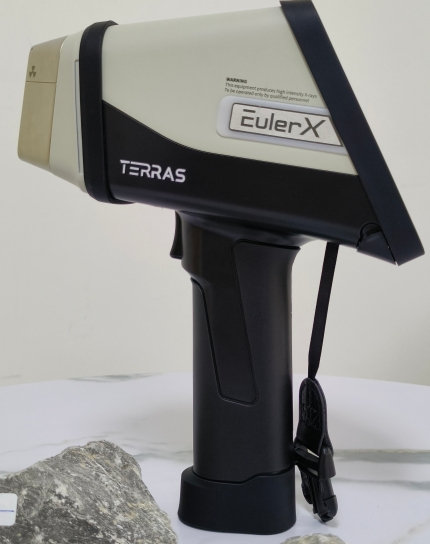
Terras EulerX600 Handheld Soil Analyzer
The Bottom Line
Viewing portable XRF and lab analysis as competitors is a false dichotomy. Portable XRF empowers you to ask smarter questions, and laboratory analysis provides the definitive answers.
By understanding their distinct roles, you can design a soil testing strategy that is not only faster and more insightful but also more robust and cost-effective, perfectly tailored to your project's unique requirements.
About Terra Scientific
Terra Scientific is a high-tech manufacturer specializing in the development and application of X-ray technology products. We are committed to becoming a world-class provider of X-ray industrial inspection solutions. Terra Scientific currently offers a range of products to global customers, including handheld alloy analyzer, handheld precious metal analyzer, handheld mining analyzer, benchtop precious metal analyzers, in-line analyzer, and spectrometer modules, along with XRF analyzers. We continuously serve global clients in fields such as mechanical manufacturing, metal processing, aerospace, petrochemicals, mining and geology, food safety, environmental protection, and scientific research.
To learn more, please don't hesitate to contact us via email at sales@terra-scientific.com, or visit our website at http://www.terra-scientific.com
Join Us
Subscribe to our email list for updates & promotions.