 English
 Russian
 French
 Spanish
 Portuguese
 Arabic
 Vietnamese
 Turkish
Alloy
A high-tech enterprise focusing on the development and application of X-ray technology products, committed to becoming a leading supplier of X-ray industrial testing solutions.
5 Critical Factors to Consider Before Buying a Metal Testing Gun
Investing in a handheld metal testing gun—an X-ray Fluorescence (XRF) or Laser-Induced Breakdown Spectroscopy (LIBS) analyzer—is a significant decision for any business that works with metals. It’s not just about purchasing a tool; it's about empowering your team with speed, accuracy, and confidence. But with so many models on the market, how do you choose the right one? Simply buying the most expensive model isn't the answer. The key is to match the instrument's capabilities to your specific needs.
Here are the five critical factors you must evaluate before making your purchase.
1. What Are You Testing? (The Alloy Range & Application)
This is the most important starting point. The "best" gun is the one that excels at your job.
Alloy Types: Are you primarily sorting common stainless steels (e.g., 304 vs 316), verifying aluminum grades, identifying high-temperature alloys like Inconel, or analyzing precious metals? Ensure the gun's installed calibration or method packages (often called "modes") are specifically designed for your materials. Some guns are optimized for light elements (like magnesium, aluminum, silicon), which is crucial for aerospace aluminum alloys, while others are powerhouses for heavy and precious metals.
Application: Is it for:
Positive Material Identification (PMI) for safety and quality compliance?
Scrap sorting for fast, high-volume decisions?
Incoming material inspection at the warehouse door?
Archaeology or precious metal analysis?
Your primary use case will dictate priorities in speed, precision, and regulatory compliance.

2. Analytical Performance: Precision vs. Speed
You often can't have the ultimate in both at the same time, so you need to prioritize.
Detection Limits & Precision: How low of a concentration do you need to detect? For critical PMI where a small amount of molybdenum differentiates 316 from 304 stainless, you need excellent light-element detection and precision. Review the manufacturer's specification sheets for Minimum Detection Limits (MDLs) for the key elements in your alloys.
Analysis Speed: Determine your operational tempo. Many guns offer a "fast sort" mode and a "precision lab" mode.
3. Usability & Durability (The Jobsite Reality)
A fragile, complicated instrument will collect dust if it’s not built for your environment.
Ruggedness: Is it rated for IP54 (splash/dust resistant) or the much more robust IP65 (dust-tight and protected against water jets)? Does it have a military-grade (MIL-STD) drop rating? For field use in mining or construction, durability is non-negotiable.
Ergonomics & Interface: Is the gun lightweight and balanced for all-day use? Is the touchscreen interface intuitive, even while wearing work gloves? Can results be displayed in large, clear fonts with immediate color-coded pass/fail indicators?
Battery Life: Does it have hot-swappable batteries for continuous 24/7 operation? A minimum of 8-10 hours per charge is standard for a full shift.
4. Connectivity, Software, and Data Integrity
A metal testing gun is a data-generating machine. Its value is unlocked when that data is actionable and traceable.
Reporting & Compliance: Does the software automatically generate detailed reports with timestamps, GPS coordinates (if applicable), and operator IDs? This is essential for audit trails in regulated industries (ASME, ISO, NADCAP). Can it be customized with your company logo and fields?
Connectivity: Look for Wi-Fi, Bluetooth, and USB-C for seamless transfer of results to a cloud platform, a laptop, or a printer directly on site. Cloud-based data management platforms are now a key feature, allowing managers to view results from the field in real time.
Security & User Management: Can you create multiple user logins with different permission levels to prevent unauthorized changes to calibrations?
5. Total Cost of Ownership (TCO) & Support
The purchase price is just the first cost.
Calibration & Certification: How often does the unit need factory recalibration, and what is the cost? Does the manufacturer provide ISO 17025 accredited calibration certificates?
Service & Support: What is the warranty period? Is there a comprehensive service plan available? Most critically, what is the local support network like? Having a qualified applications specialist or service engineer within reach can save immense downtime.
Accessories: Factor in the cost of necessary accessories: different sized test stands for small parts, protective shields (windows), extended warranties, and specialized calibration check samples.
Your Action Plan Before You Buy
Define Your Requirements: Write down your top 5 alloys, the key elements, and your required analysis time.
Get a Demo with Your Samples: Never buy based on a demo with the manufacturer's perfect, clean sample. Bring your own real-world, corroded, small, weirdly-shaped items to the test. This reveals true performance.
Ask for a Rental or Trial: Many suppliers offer short-term rentals. This is the best way to see how the gun performs in your actual workflow and gains user acceptance from your team.
Scrutinize the Quote: Ensure it includes all necessary calibrations, basic accessories, initial training, and clarifies the first-year support costs.
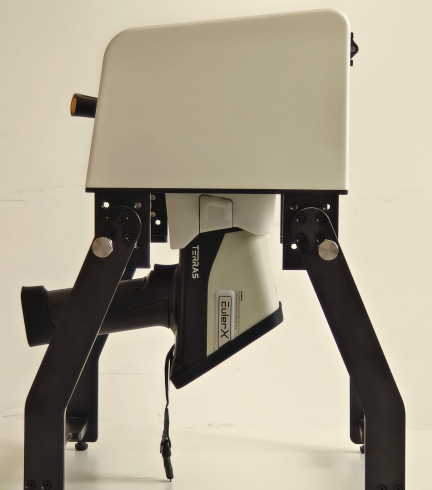
Terras EulerX900 Handheld Alloy Analyzer
Since its introduction decades ago, XRF spectrometry has become a proven and widely used technique for metal analysis, prized for its mobility, ease of use, and minimal maintenance. The EulerX 900 series handheld alloy analyzers exemplify these advantages, delivering rapid, accurate, lab-quality results for alloy identification, quality control, scrap recycling, and PMI. With advanced electronics and algorithms, it provides non-destructive testing within seconds on various sample forms—solids, liquids, and powders—requiring minimal training and little to no sample preparation.
By carefully weighing these five factors, you’ll move beyond marketing claims and select a metal testing gun that becomes a reliable, profit-protecting partner for your business for years to come. Make an informed investment, and let precision drive your progress.
About Terra Scientific
Terra Scientific is a high-tech manufacturer specializing in the development and application of X-ray technology products. We are committed to becoming a world-class provider of X-ray industrial inspection solutions. Terra Scientific currently offers a range of products to global customers, including handheld alloy analyzer, handheld precious metal analyzer, handheld mining analyzer, benchtop precious metal analyzers, in-line analyzer, and spectrometer modules, along with XRF analyzers. We continuously serve global clients in fields such as mechanical manufacturing, metal processing, aerospace, petrochemicals, mining and geology, food safety, environmental protection, and scientific research.
To learn more, please don't hesitate to contact us via email at sales@terra-scientific.com, or visit our website at http://www.terra-scientific.com
Join Us
Subscribe to our email list for updates & promotions.