 English
 Russian
 French
 Spanish
 Portuguese
 Arabic
 Vietnamese
 Turkish

Alloy
A high-tech enterprise focusing on the development and application of X-ray technology products, committed to becoming a leading supplier of X-ray industrial testing solutions.
Beyond the Beep: How to Use Handheld XRF Like a Pro for Superior Data Quality
You’ve unboxed your shiny new handheld XRF analyzer. You’ve read the manual, you point it at a sample, pull the trigger, and… beep. A list of numbers appears on the screen. Job done, right?
Not quite.
For many, the handheld XRF remains a "black box" that magically spits out data. But in the hands of a true professional, it transforms from a simple gun into a powerful decision-making engine. The difference between good data and superior data lies not in the tool itself, but in the techniques and understanding of the person wielding it.
Moving beyond the beep means understanding the science, respecting the process, and mastering the nuances. Ready to elevate your game? Let's dive in.

1. The Foundation: It All Starts with Sample Prep
This is the single most overlooked step, and the biggest differentiator between amateurs and pros. The analyzer can only measure what it can see.
Surface is King: A rough, porous, or irregular surface scatters X-rays, leading to inaccurate and inconsistent results. For solid metals, use a grinder to create a flat, clean, representative surface. For powders, ensure they are finely milled and homogenous.
Consistency is Queen: Prepare all your samples the same way. If you grind one piece of scrap metal but not the next, you’re introducing a major variable that will skew your data comparison.
The Right Fit: For small or irregularly shaped items, use a test stand to maintain a consistent distance and geometry. The "spot size" of the X-ray beam is small, and missing the sample or analyzing an edge can give you the composition of the air or your workbench!
Pro Tip: For loose materials like soils or powders, use premium XRF cups with prolene film. They provide a consistent, reproducible presentation for the analyzer.
2. Master Your Measurement Mode
Your analyzer isn't a one-trick pony. It comes with optimized modes for a reason.
Mining & Exploration Mode: Tailored for light elements in a soil/rock matrix. It uses a helium purge or vacuum to detect magnesium, aluminum, and silicon accurately.
Alloys & Metals Mode: Optimized for a metal matrix, providing incredibly precise readings for elements like chromium, nickel, and molybdenum in seconds.
Plastics & Consumer Goods Mode: Configured to detect restricted substances like lead (Pb), cadmium (Cd), mercury (Hg), and bromine (Br) at low concentrations.
Using the "Geology" mode to analyze a stainless steel pipe will give you data, but it won't be the high-precision data you need for a critical material passivation check.
Pro Tip: Don't just rely on the default "General" mode. Take the time to select the specific mode that matches your sample type for optimal excitation and detection.
3. The Art of the Aim: Geometry and Time
Where you point and how long you measure are critical.
Fill the Beam: Ensure your sample is large enough to completely cover the analyzer’s aperture. If the beam spills over the edge, you're diluting your sample's signal with the background.
Stay Steady: Movement during analysis is the enemy. Use a test stand whenever possible. If handholding is necessary, brace your arms against your body or a stable surface. A wobbly gun creates a wobbly spectrum.
Time is Precision: A 3-second reading is a screening test. A 30-second reading is a quantitative analysis. Longer measurement times allow the detector to collect more X-ray counts, significantly improving precision and lowering detection limits for trace elements. When in doubt, measure longer.
Pro Tip: For critical applications, take multiple readings on different spots of the same sample and average the results. This accounts for micro-scale heterogeneity.
4. Become Best Friends with Standards and QC
A pro never trusts a tool blindly; they verify it.
Calibration Checks: Regularly analyze a certified reference material (CRM) that is similar to your samples. Is your analyzer reading 304 stainless steel as 304? If not, you know it’s time for a service or recalibration.
Create Your Own QC: Don't have a CRM? Preserve a well-characterized sample from your own process (a "secondary standard") and use it to check the analyzer's performance daily or weekly. This tracks instrument drift over time.
Pro Tip: Keep a log of your QC checks. This logbook is your golden ticket when someone questions your data, proving your process is rigorous and reliable.
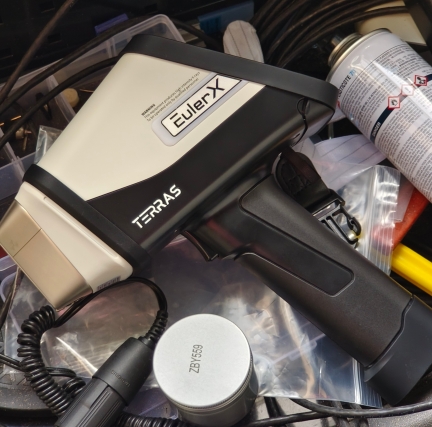
Terras EulerX900S Handheld Alloy Analyzer
5. Context is Everything: You Are the Brain
The XRF is a brilliant instrument, but it's not intelligent. It reports elemental composition; you provide the context and interpretation.
Understand the Matrix: The analyzer uses fundamental parameters and empirical calibrations to calculate concentrations. A reading of 70% iron means something very different in a soil sample than it does in a steel sample. You must tell the analyzer what kind of matrix it's measuring (via the correct mode) and interpret the results accordingly.
Look for the Whole Picture: Don't just focus on the target element. Look at the entire spectrum. Are there unexpected trace elements? Does the sum of the concentrations make sense? Anomalies can tell a story—contamination, a mixed alloy, or an incorrect calibration.
Take the lab anywhere. The EulerX900S XRF Spectrometer delivers instant, non-destructive elemental analysis from Mg to U. This rugged, portable device identifies alloys, metals, and contaminants with a touchscreen interface and seamless Wi-Fi/USB reporting—ideal for QA, scrap sorting, and environmental testing.
Conclusion: From Data Point to Decision Point
Using a handheld XRF like a pro is about shifting your mindset. It’s not just about getting a number; it’s about generating a reliable, defensible, and actionable piece of information.
By mastering sample preparation, selecting the right method, ensuring measurement stability, implementing rigorous QC, and applying your expert context, you move far beyond the simple beep. You transform raw data into a strategic asset that drives efficiency, ensures safety, and delivers superior results.
So, the next time you pick up your analyzer, remember: you're not just holding a gun. You're holding the key to deeper insight. Use it wisely.
About Terra Scientific
Terra Scientific is a high-tech manufacturer specializing in the development and application of X-ray technology products. We are committed to becoming a world-class provider of X-ray industrial inspection solutions. Terra Scientific currently offers a range of products to global customers, including handheld alloy analyzer, handheld precious metal analyzer, handheld mining analyzer, benchtop precious metal analyzers, in-line analyzer, and spectrometer modules, along with XRF analyzers. We continuously serve global clients in fields such as mechanical manufacturing, metal processing, aerospace, petrochemicals, mining and geology, food safety, environmental protection, and scientific research.
To learn more, please don't hesitate to contact us via email at sales@terra-scientific.com, or visit our website at http://www.terra-scientific.com
Join Us
Subscribe to our email list for updates & promotions.