 English
 Russian
 French
 Spanish
 Portuguese
 Arabic
 Vietnamese
 Turkish

Alloy
A high-tech enterprise focusing on the development and application of X-ray technology products, committed to becoming a leading supplier of X-ray industrial testing solutions.
Beyond the Numbers: Understanding Precision vs. Accuracy in XRF Gun Readings
You’ve invested in an XRF gun—a powerful piece of technology that puts elemental analysis right in the palm of your hand. You point, you shoot, and in seconds, you get a number. It’s tempting to take that reading as an absolute truth, a definitive verdict on the material in front of you.
But here’s the catch: that number is just the beginning of the story. To truly trust your data and make confident decisions, you need to understand two fundamental concepts: precision and accuracy.
While often used interchangeably in everyday language, in the world of scientific measurement, they are distinct—and mastering the difference is the key to unlocking the full potential of your XRF analyzer.
The Dartboard Analogy: A Classic for a Reason
The easiest way to visualize precision and accuracy is with a dartboard.
High Accuracy, Low Precision: Your darts are scattered all around the board, but their average position is right at the bullseye. You’re correct on average, but individual throws are unreliable.
High Precision, Low Accuracy: Your darts are tightly clustered together, but they’re all in the top-left corner, far from the bullseye. You are very consistent, but consistently wrong.
High Precision & High Accuracy: Your darts are tightly clustered and right in the bullseye. This is the ideal scenario—consistent and correct results.

Applying the Concepts to Your XRF Gun
So, how does this translate to the numbers on your XRF screen?
Accuracy: How Close You Are to the Truth
Accuracy refers to how close a single measurement is to the material's true chemical composition. This is the "correctness" of your reading.
In Practice: If you are analyzing a stainless steel scrap piece with a known chromium content of 18.5%, an accurate XRF gun will read very close to 18.5%.
What Affects Accuracy?
Calibration: The instrument must be calibrated correctly against certified reference materials (CRMs).
Matrix Effects: The base material (e.g., steel vs. aluminum) can influence the reading of other elements.
Surface Condition: Roughness, curvature, oxidation, and plating can all skew results away from the true value.
Precision: How Consistent You Are
Precision (or repeatability) refers to how close repeated measurements are to each other when you analyze the same spot under the same conditions. It’s about consistency and reliability.
In Practice: If you take ten readings on the same clean, flat spot of that stainless steel piece, a precise XRF gun will give you ten results that are all very similar (e.g., 18.4%, 18.5%, 18.4%).
What Affects Precision?
Counting Statistics: XRF works by counting X-ray photons. A longer analysis time typically increases the count, leading to more precise results.
Instrument Stability: A well-maintained device with a stable X-ray tube and detector will produce more consistent results.
Operator Technique: Small movements or a shaky hand can change the measurement geometry slightly, affecting consistency.
Why This Distinction Matters in the Real World
You might be thinking, "I just need a number to sort my scrap metal." But understanding this distinction is crucial for:
Quality Control & Alloy Verification: High precision ensures you can reliably sort materials into consistent batches. High accuracy ensures you aren't accidentally passing off or rejecting a material based on an incorrect grade identification. A misidentified high-temperature alloy in an aerospace application could have catastrophic consequences.
Scrap Metal Sorting: A precise gun will give you the same reading on a pile of shredded aluminum, allowing for fast, consistent sorting. However, if the gun isn't accurate (perhaps due to a dirty lens or wrong calibration), you might consistently mis-sort an entire load, costing you thousands.
Regulatory Compliance & Environmental Testing: When testing for lead in paint or restricted substances in consumer goods, you need accuracy. A result that is precisely wrong could lead to false negatives (leaving a hazard in place) or false positives (unnecessary and costly remediation).
How to Ensure Both Precision and Accuracy in Your Work
You are not at the mercy of your instrument. You can actively improve both aspects of your measurements.
For Better Accuracy:
Calibrate Regularly: Follow the manufacturer’s guidelines and use appropriate CRMs.
Prepare the Sample: Whenever possible, create a clean, flat, homogeneous testing surface.
Use the Correct Mode: Ensure you’ve selected the correct application mode (e.g., "Alloy," "Soil," "Plastics") for your material.
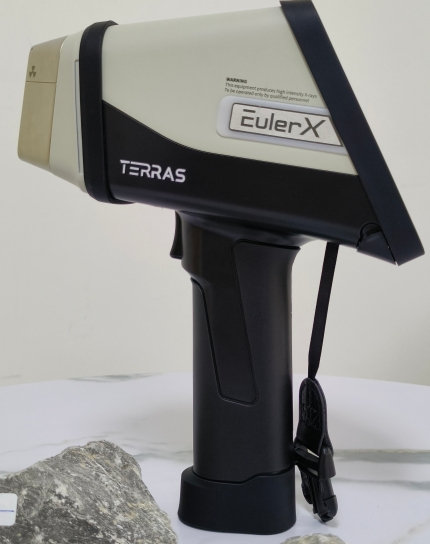
Terras EulerX900S Handheld Alloy Analyzer
For Better Precision:
Increase Counting Time: A longer analysis time smooths out statistical noise.
Use a Test Stand: This eliminates human error from hand-shaking and ensures a consistent measurement geometry.
Take Multiple Readings: Don't rely on a single measurement. Take 3-5 readings and average them for a more reliable result.
Revolutionize field-based elemental analysis with the EulerX900S XRF Spectrometer. This portable instrument provides immediate, non-destructive quantification of elements from Magnesium to Uranium. Its robust design, intuitive touchscreen, and integrated Wi-Fi/USB connectivity enable efficient data reporting for critical tasks in quality assurance, material sorting, and environmental screening.
The Bottom Line
Your XRF gun is a powerful tool, but it is not a magic wand. The number it provides is a data point that must be interpreted with skill and understanding.
By moving beyond the numbers and grasping the critical difference between precision and accuracy, you transform from someone who just "shoots and reads" into a true expert who can validate data, troubleshoot issues, and make decisions with absolute confidence.
So the next time you pick up your analyzer, remember the dartboard. Ask yourself: Am I being consistent? And am I hitting the bullseye?
About Terra Scientific
Terra Scientific is a high-tech manufacturer specializing in the development and application of X-ray technology products. We are committed to becoming a world-class provider of X-ray industrial inspection solutions. Terra Scientific currently offers a range of products to global customers, including handheld alloy analyzer, handheld precious metal analyzer, handheld mining analyzer, benchtop precious metal analyzers, in-line analyzer, and spectrometer modules, along with XRF analyzers. We continuously serve global clients in fields such as mechanical manufacturing, metal processing, aerospace, petrochemicals, mining and geology, food safety, environmental protection, and scientific research.
To learn more, please don't hesitate to contact us via email at sales@terra-scientific.com, or visit our website at http://www.terra-scientific.com
Join Us
Subscribe to our email list for updates & promotions.