 English
 Russian
 French
 Spanish
 Portuguese
 Arabic
 Vietnamese
 Turkish
Alloy
A high-tech enterprise focusing on the development and application of X-ray technology products, committed to becoming a leading supplier of X-ray industrial testing solutions.
Budgeting for an XRF Gun: Key Factors That Influence the Final Price
So, you’ve decided it’s time to invest in an XRF analyzer. You’ve seen the incredible value it can bring—from speeding up material verification and streamlining quality control to unlocking new revenue streams in scrap recycling. Your first instinct might be to search for a price tag, but you’ll quickly find that the answer isn't so simple.
The cost of an XRF gun can range from that of a well-equipped family car to a small house. Why the massive disparity? The final price isn't just about the hardware; it's about the capabilities, support, and long-term value it delivers.
Moving beyond the initial sticker shock requires a deeper understanding of what you're really paying for. Let's break down the key factors that influence the final price of an XRF analyzer.
1. The Core Technology: What’s Inside the Box?
This is the most significant driver of cost. Not all XRF guns are created equal.
Benchtop vs. Handheld: Benchtop units are typically more powerful, offering superior detection limits for trace elements, but they lack portability and come with a higher price tag. Handheld (HHXRF) units provide unparalleled flexibility for fieldwork but have different performance specifications.
Detector Type: The heart of the analyzer. Silicon Drift Detectors (SDD) are the modern standard for fast, high-resolution analysis, ideal for a wide range of applications. They are more expensive than older PIN Diode Detectors, which are slower and less precise but can be a cost-effective solution for simpler tasks like alloy sorting.
X-Ray Tube vs. Radioisotope Source: Most modern handheld units use miniaturized X-ray tubes. Tubes offer greater control, longer life, and no radioactive licensing hassles, but they add to the cost and complexity. While less common now, isotope-based systems can be cheaper upfront for specific, dedicated applications.

2. Application & Performance: What Do You Need It to Do?
Your specific use case directly dictates the required performance—and the corresponding budget.
Elemental Range: Do you need to measure light elements like magnesium (Mg), aluminum (Al), silicon (Si), and phosphorus (P)? Analyzing these elements is technologically challenging and requires a more sophisticated (and expensive) instrument with a helium purge or vacuum pump. If you only need to identify stainless steels (Cr, Ni, Mo) or heavy metals, a more standard, less costly model may suffice.
Detection Limits: How low do you need to go? Ensuring a cadmium coating is below 100 ppm for RoHS compliance requires an extremely sensitive instrument. Verifying that a piece of scrap is 304 vs. 316 stainless steel is a much easier task. The lower the detection limits required, the higher the price.
Precision and Speed: Does your process require results in one second, or is three seconds acceptable? Higher precision and faster analysis times are hallmarks of more advanced—and more expensive—systems.
3. The "Whole Product" Ecosystem
The gun itself is just one piece of the puzzle. The ecosystem surrounding it is crucial for long-term success.
Software & Calibrations: Is the software intuitive? Does it come with pre-loaded, factory-calibrated methods for your specific materials (e.g., "Stainless Steel 300 Series," "Brass Alloys")? Developing custom calibrations from scratch is time-consuming and expensive. A higher initial investment often includes a robust, user-friendly software suite and a comprehensive library of ready-to-use calibrations.
Training and Support: What happens when you have a question or the instrument fails? The value of comprehensive training, responsive technical support, and a reliable service network cannot be overstated. A cheaper instrument from a company with poor support can become a very expensive paperweight.
Warranty and Service Plans: A longer warranty (e.g., 3 years vs. 1 year) provides peace of mind but is often reflected in the purchase price. Understand what the warranty covers (tube, detector, etc.) and the cost of annual service plans to keep your instrument in peak condition.
4. Regulatory Compliance & Accessories
Don’t forget the essential (and sometimes mandatory) extras.
Safety Features and Licensing: All XRF devices are regulated for safety. Ensure the model you choose has the necessary interlocks and safety certifications. While not a direct cost, understanding the regulatory environment is part of the total cost of ownership.
Essential Accessories: The base price might not include critical items like:
Test Stand: For hands-free, reproducible analysis of small or oddly shaped items.
Helium Purge System/Vacuum Pump: Mandatory for light element analysis.
Protective Cases & Armor: For harsh field environments.
Extended Batteries and Chargers: For all-day operation.
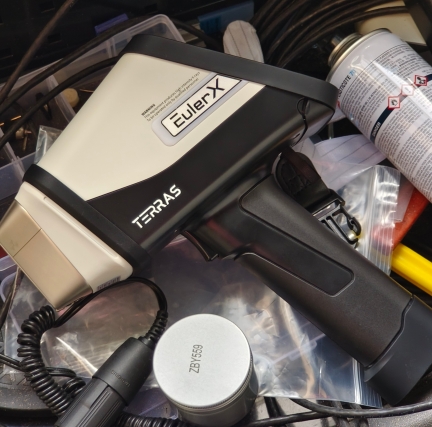
Terras EulerX900S Handheld Alloy Analyzer
Building Your Budget: A Practical Approach
Instead of asking "How much is an XRF gun?", start by asking:
What specific business problem am I solving? (e.g., "Reduce material mix-ups on the production line," "Accurately grade incoming scrap metal.")
For professionals in QA, scrap metal, or environmental services, the EulerX900S is your mobile lab. Leave the guesswork behind and get immediate, on-site identification of elements from Mg to U. Non-destructively analyze metals, alloys, and contaminants, then streamline reports with the touchscreen and Wi-Fi/USB connectivity—all in a tough, go-anywhere package.
What elements do I need to measure, and to what levels? (Create a detailed list.)
Who will be using it, and in what environment? (Lab, factory floor, outdoors?)
What does "success" look like in 1, 3, and 5 years? (Consider ROI, uptime, and scalability.)
Armed with these answers, you can have an informed conversation with suppliers. You’re no longer just comparing numbers; you’re evaluating solutions.
The Bottom Line
Budgeting for an XRF gun is an investment in accuracy, efficiency, and profitability. While the initial price is important, the true cost is measured over the instrument's entire lifecycle. By looking beyond the numbers and focusing on the factors that drive value—technology, application, and support—you can make a confident investment that pays dividends for years to come.
About Terra Scientific
Terra Scientific is a high-tech manufacturer specializing in the development and application of X-ray technology products. We are committed to becoming a world-class provider of X-ray industrial inspection solutions. Terra Scientific currently offers a range of products to global customers, including handheld alloy analyzer, handheld precious metal analyzer, handheld mining analyzer, benchtop precious metal analyzers, in-line analyzer, and spectrometer modules, along with XRF analyzers. We continuously serve global clients in fields such as mechanical manufacturing, metal processing, aerospace, petrochemicals, mining and geology, food safety, environmental protection, and scientific research.
To learn more, please don't hesitate to contact us via email at sales@terra-scientific.com, or visit our website at http://www.terra-scientific.com
Join Us
Subscribe to our email list for updates & promotions.