 English
 Russian
 French
 Spanish
 Portuguese
 Arabic
 Vietnamese
 Turkish

soil
A high-tech enterprise focusing on the development and application of X-ray technology products, committed to becoming a leading supplier of X-ray industrial testing solutions.
Lab Analysis vs. Portable XRF Soil Testing: Understanding the Trade-Offs
Deciding how to test your soil is one of the most critical choices in environmental science, agriculture, or remediation. For decades, traditional laboratory analysis was the undisputed gold standard. Today, portable X-ray fluorescence (pXRF) analyzers offer a powerful alternative right at your fingertips. But which one is right for your project?
The answer isn't a simple "one is better." It's about understanding the trade-offs between ultimate accuracy and actionable speed. This guide breaks down the key differences to help you make an informed decision.
The Contenders: A Quick Introduction
Laboratory Analysis (ICP-OES/MS, AAS):
Samples are collected, carefully prepared (dried, sieved, digested in strong acids), and sent to a certified lab. Sophisticated instruments like Inductively Coupled Plasma (ICP) spectrometers provide extremely detailed and accurate data on a vast array of elements, often at very low concentrations (parts per billion).
Portable XRF Soil Testing:
A handheld device is brought directly to the field. It works by emitting an X-ray beam into the soil, causing elements to fluoresce. The detector then measures this unique fluorescent energy to identify and quantify elements present

The Trade-Offs Breakdown
1. Accuracy & Detection Limits: The Precision of the Lab
Lab Analysis (WIN): This is the lab's core strength. Wet chemistry methods can detect trace elements at incredibly low levels (parts per billion, or ppb). They are minimally affected by soil moisture, density, or texture, and they are the benchmark for regulatory compliance.
Portable XRF: pXRF is less sensitive, with detection limits typically in the parts per million (ppm) range. Its readings can be influenced by soil moisture (water scatters X-rays), particle size, and heterogeneity. For definitive, court-admissible data on trace contaminants, the lab is still king.
Trade-Off: Ultimate Accuracy vs. Field-Practical Sensitivity. The lab wins on precision, but for many common targets (e.g., lead > 200 ppm, high levels of arsenic, or major nutrients), pXRF is more than sufficient.
2. Speed & Timeliness: The Power of Real-Time Data
Portable XRF (WIN): This is pXRF's game-changing advantage. Get results in seconds to minutes while still on-site. This enables real-time decision-making: "Should I sample here? Is this hotspot contained? What's the boundary of this contaminant plume?"
Lab Analysis: Turnaround times are measured in days or weeks, factoring in shipping, lab queue times, and the multi-step preparation and analysis process.
Trade-Off: Immediate Insight vs. Delayed Confirmation. pXRF gives you a map in real-time; the lab provides the highly detailed, verified cartography later.
3. Cost: A Matter of Scale and Purpose
Portable XRF: Higher upfront investment (instrument purchase/rental), but very low cost per sample after that (just the operator's time). This makes it exceptionally cost-effective for high-density sampling (e.g., 100s of points on a grid).
Lab Analysis: Lower upfront cost (just sampling supplies), but high cost per sample, which can quickly balloon on large projects. Each element analyzed often adds to the cost.
Trade-Off: High-Volume Affordability vs. Low-Volume Accessibility. For a small, one-off test, the lab is affordable. For characterizing an entire brownfield site, pXRF is vastly more economical.
4. Data Density & Sampling Strategy
Portable XRF (WIN): Because it's so fast and cheap per reading, you can take hundreds or thousands of data points. This creates incredibly detailed contaminant maps and reveals spatial patterns and hotspots that a handful of lab samples could easily miss.
Lab Analysis: The cost and time per sample naturally limit the number of samples you can practically submit. Sampling is therefore more strategic, targeting suspected areas.
Trade-Off: Seeing the Whole Picture vs. Targeting Specific Points. pXRF shows you the forest; lab tests can definitively identify specific trees.
5. Workflow & Flexibility
Portable XRF (WIN): Enables adaptive sampling. You can see a result and immediately decide to sample 10 feet to the left to track a gradient. It simplifies screening and triage, allowing you to send only the most critical, representative samples to the lab for confirmation.
Lab Analysis: Follows a linear, predetermined path: collect samples according to a plan, ship them off, and wait. There's no opportunity for in-field course correction.
Trade-Off: Adaptive Investigation vs. Planned Protocol. pXRF is agile; lab work is methodical.
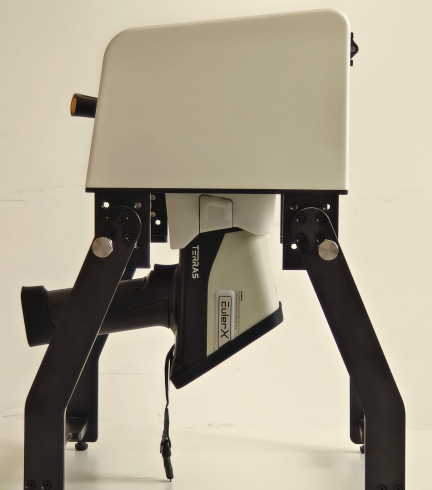
Terras EulerX600 Handheld Soil Analyzer
Heavy metal pollutants in soil remain hazardous for years, originating from industrial activities, agricultural chemicals, and improper waste disposal. Screening and remediation are therefore critical challenges. Handheld XRF analysis, such as with the EulerX 600 soil analyzer, enables rapid on-site detection of heavy metals like cadmium, mercury, lead, and chromium. This significantly reduces the need for lab samples, cutting costs and time, while allowing efficient delineation of contaminated zones to minimize remediation expenses.
Ultimately, the "best" method is the one that most efficiently meets your project's specific goals for accuracy, speed, and cost. By understanding these fundamental trade-offs, you can deploy the right tool—or the right combination of tools—to gain the clearest possible picture of what lies beneath.
About Terra Scientific
Terra Scientific is a high-tech manufacturer specializing in the development and application of X-ray technology products. We are committed to becoming a world-class provider of X-ray industrial inspection solutions. Terra Scientific currently offers a range of products to global customers, including handheld alloy analyzer, handheld precious metal analyzer, handheld mining analyzer, benchtop precious metal analyzers, in-line analyzer, and spectrometer modules, along with XRF analyzers. We continuously serve global clients in fields such as mechanical manufacturing, metal processing, aerospace, petrochemicals, mining and geology, food safety, environmental protection, and scientific research.
To learn more, please don't hesitate to contact us via email at sales@terra-scientific.com, or visit our website at http://www.terra-scientific.com
Join Us
Subscribe to our email list for updates & promotions.