 English
 Russian
 French
 Spanish
 Portuguese
 Arabic
 Vietnamese
 Turkish
Alloy
A high-tech enterprise focusing on the development and application of X-ray technology products, committed to becoming a leading supplier of X-ray industrial testing solutions.
The Benchtop XRF Buyer's Guide: Key Specs and Questions to Ask
So, you’ve decided a benchtop XRF analyzer is the right tool to elevate your quality control, research, or material verification processes. That’s a fantastic step. But if you’ve started looking at brochures and spec sheets, you know it can feel like drowning in a sea of technical jargon: keV, µm, ppm, silicon drift detectors, helium purge...
It’s easy to get lost in the numbers. But the truth is, the best XRF for your lab isn't always the one with the highest specs on paper. It's the one that solves your specific problems efficiently, reliably, and within your budget.
This guide is designed to move beyond the numbers and help you ask the right questions to find the perfect instrument for your needs.

The Core Specs: What They Really Mean
Let's break down the key specifications and translate them into real-world impact.
1. Elemental Range: What Can You Actually Detect?
The Spec: Typically listed as "Elements from Na to U" or "Mg to U."
What it Means: This defines the lightest and heaviest elements the instrument can detect. A system that starts at Sodium (Na) or Magnesium (Mg) can analyze lighter elements like aluminum, silicon, and phosphorus, which is critical for alloys, ceramics, and polymers. If you only need to analyze heavy metals (like lead, cadmium, or mercury), a instrument starting at Sulfur (S) might suffice and be more cost-effective.
The Key Question: "Based on my most common samples (e.g., stainless steel, plastics, mining ores), what is the lightest element I need to quantify?"
2. Detection Limits (LLD): How Little Can You See?
The Spec: Listed in parts per million (ppm) for specific elements.
What it Means: The Lower Limit of Detection is the smallest amount of an element the instrument can reliably detect. A lower number is better, but context is everything. A spec of 2 ppm for Cadmium is impressive, but if your regulatory threshold is 100 ppm, you have a comfortable margin.
The Key Question: "What are my compliance or internal specification limits, and does the instrument's LLD provide a sufficient safety margin?"
3. X-Ray Tube & Detector: The Engine and the Ears
The Specs: Tube voltage (kV), anode material (Rh, Au, Mo), and detector type (Si-PIN, Silicon Drift Detector - SDD).
What it Means: This is the heart of the system. A higher power tube (e.g., 50W vs. 4W) and an SDD detector generally provide faster analysis and better light-element performance. The anode material (Rhodium is most common) influences which elements fluoresce most efficiently.
The Key Question: "For my required throughput and the elements I need to measure, what tube/detector combination offers the best balance of speed and performance without overpaying for power I won't use?"
4. Sample Chamber & Viewing: How Easy Is It to Use?
The Spec: Chamber size (e.g., 300mm x 300mm) and camera systems.
What it Means: A large chamber is essential for oversized or irregularly shaped samples. A high-resolution camera with a live video feed and spot-marking capability is not a luxury—it's crucial for precisely targeting small features, inclusions, or coatings.
The Key Question: "What is the largest sample I need to analyze, and how small is the smallest feature I need to target?"
Crucial Questions to Ask During Your Demo
A spec sheet is a starting point. The real evaluation happens during a live demonstration with your own samples. Don't just watch; interrogate the process.
1. "Can we test my samples?"
This is non-negotiable. Bring your most challenging, most common, and most critical samples. Does it struggle with a rough, pitted casting? Can it handle a thin, flexible plastic film? Your samples are the ultimate test.
2. "How easy is the software to use day-to-day?"
Look for intuitive, workflow-driven software. Can your operators learn it quickly? How many clicks does it take to go from turning on the instrument to getting a result? Is the data export and reporting flexible for your needs?
3. "What does the 'total cost of ownership' look like?"
Look beyond the initial price tag.
Consumables: What is the cost and lifespan of the helium gas (if needed for light elements) and the calibration standards?
Service & Support: What does the warranty cover? What are the costs for annual preventative maintenance? How responsive is the local service team?
Training: Is comprehensive training included, or is it an added cost?
4. "What kind of calibration and method development do you provide?"
A machine is only as good as its calibration. Does the vendor provide ready-made calibrations for your application (e.g., "Low Alloy Steel")? How easy is it to create a custom calibration for a unique material? Ask to see the process.
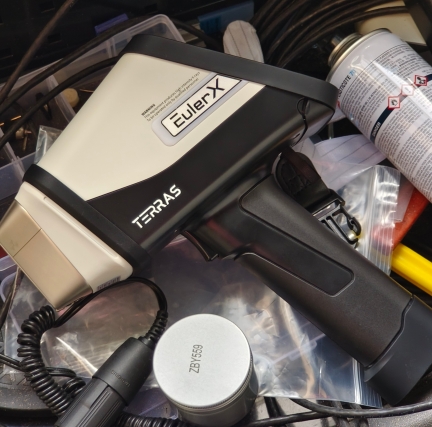
Terras EulerX900S Handheld Alloy Analyzer
5. "What safety features are in place?"
Benchtop XRF is exceptionally safe when interlock systems are functioning. Ensure the demo unit has multiple, redundant safety interlocks that immediately shut off the X-rays when the door is opened. This is paramount for lab safety.
Redefine the possibilities of on-site analysis. The EulerX900S XRF Spectrometer empowers you with laboratory-grade elemental data—from Magnesium to Uranium—directly in the field. Experience instantaneous, non-destructive testing of metals, alloys, and contaminants. Combined with a rugged, portable design, an intuitive touchscreen, and effortless data sharing, it is the ultimate mobile analysis platform for demanding applications.
The Final Verdict: It's About Partnership
Choosing a benchtop XRF is a significant investment. The right vendor won't just sell you an instrument; they will become a partner. They will understand your application, provide robust training and support, and be there to help you troubleshoot and maintain your instrument for years to come.
By looking beyond the raw numbers and focusing on these practical questions, you'll move from being a confused buyer to a confident decision-maker, ready to select the analytical partner that will deliver precise, reliable results for your unique challenges.
About Terra Scientific
Terra Scientific is a high-tech manufacturer specializing in the development and application of X-ray technology products. We are committed to becoming a world-class provider of X-ray industrial inspection solutions. Terra Scientific currently offers a range of products to global customers, including handheld alloy analyzer, handheld precious metal analyzer, handheld mining analyzer, benchtop precious metal analyzers, in-line analyzer, and spectrometer modules, along with XRF analyzers. We continuously serve global clients in fields such as mechanical manufacturing, metal processing, aerospace, petrochemicals, mining and geology, food safety, environmental protection, and scientific research.
To learn more, please don't hesitate to contact us via email at sales@terra-scientific.com, or visit our website at http://www.terra-scientific.com
Join Us
Subscribe to our email list for updates & promotions.