 English
 Russian
 French
 Spanish
 Portuguese
 Arabic
 Vietnamese
 Turkish

Gold and Jewelry
A high-tech enterprise focusing on the development and application of X-ray technology products, committed to becoming a leading supplier of X-ray industrial testing solutions.
XRF Spectrometry for Beginners: What to Look for in a Portable Handheld XRF Analyzer
Imagine being able to tell the exact chemical composition of a piece of metal, a lump of ore, or even a suspicious stain on the ground in just a few seconds—without destroying the sample. This is the magic of X-ray fluorescence (XRF) spectrometry. Once confined to laboratory benchtops, this technology is now available in rugged, portable devices that are transforming industries from scrap recycling to archaeology .
For beginners, the world of handheld XRF analyzers can seem complex, filled with technical jargon about detectors, silicon drift detectors (SDD), and matrix effects. This guide will break down the basics of how these devices work and, more importantly, what you need to look for when choosing your first portable XRF analyzer.
How Does a Handheld XRF Analyzer Work?
Before diving into the features, it helps to understand the simple principle behind the device.
Shoot: The analyzer emits X-rays from a tube inside the handheld unit onto the material being tested .
Excite: These X-rays have enough energy to knock electrons loose from the inner shells of the atoms in the sample. When the atoms "reorganize" to fill this gap, they release energy in the form of secondary, or fluorescent, X-rays .
Measure: Each element (like iron, copper, or lead) produces fluorescent X-rays with a unique energy "fingerprint." The detector in the analyzer captures these signals, and the onboard software calculates which elements are present and in what concentration .
The entire process is non-destructive, meaning your sample remains intact .

Key Considerations When Buying Your First Portable XRF
Not all handheld XRF analyzers are created equal. Your choice should be guided by what you plan to analyze. Here are the critical factors to evaluate:
1. Identify Your Primary Application
This is the most important question you can ask. Different industries have different requirements:
Scrap Metal Recycling & PMI (Positive Material Identification): You need fast alloy grade identification and elemental chemistry matching. Speed and a library of thousands of alloys are key .
Precious Metal Identification & Testing: If you work in jewelry appraisal, refining, or pawn brokerage, you need an analyzer capable of precisely measuring the purity of precious metals like gold, silver, platinum, and palladium.
Mining & Geology: You require high sensitivity for trace elements and the ability to analyze geological samples like soils, ores, and core samples .
Environmental Testing: You will be screening soil for heavy metal contaminants like lead (Pb), arsenic (As), and cadmium (Cd). Detection limits (how low you can go) are critical here .
RoHS & Consumer Goods Compliance: You need to screen plastics and electronics for restricted substances like lead, mercury, and cadmium .
2. What Elements Do You Need to Detect?
The Light Element Challenge: Be aware that detecting "light" elements (like Magnesium, Aluminum, Silicon, and Phosphorus) is more difficult. It requires the analyzer to have a vacuum or helium purge capability because the low-energy X-rays from these elements are absorbed by air . If you analyze light elements in rocks or aluminum alloys, ensure the model you choose supports this.
Limitations: XRF cannot detect very light elements like Hydrogen, Lithium, or Beryllium, nor can it determine isotopic composition or oxidation states (e.g., Fe²⁺ vs. Fe³⁺) .
3. Performance Metrics: Detection Limits and Accuracy
Manufacturers will cite performance figures. For a beginner, focus on these:
Detection Limits: Usually expressed in parts per million (ppm). If you are looking for trace contaminants, you need an instrument with low detection limits. High-power tubes and SDD detectors generally provide lower (better) detection limits .
Repeatability (RSD%): This tells you how consistent the results are. A lower Relative Standard Deviation (RSD) means more precise results. Look for RSD < 5% for reliable analysis .
4. Built for the Field: Durability and Safety
Durability: If you're working outdoors or in a factory, the analyzer must withstand the environment. Look for an ingress protection (IP) rating like IP54 (dust and splash resistant) or even IP65, and a device that can withstand a drop from a certain height .
Ergonomics: You might be holding the device for hours. Weight matters—aim for under 1.8 kg . Battery life is also crucial; a full day's work requires at least 8 hours of operation .
Radiation Safety: Handheld XRF devices emit radiation, but they are designed with multiple safety features. Look for features like shutter sensors that stop X-ray emission when the unit is not in contact with a sample, and ensure the device meets international safety standards .
5. Software and Reporting
A powerful analyzer is useless if you can't understand the data. Look for:
Intuitive User Interface: A touchscreen interface that is easy to navigate, even with gloves on, is a major plus .
Grade Libraries: For metal sorting, the device should come pre-loaded with a vast library of alloy grades (e.g., for stainless steel, aluminum, etc.) .
Data Management: Can you easily generate PDF or Excel reports? Can you transfer data via Bluetooth or WiFi? Seamless data export is essential for record-keeping and compliance .
Handheld vs. Benchtop: Are You Sure You Need Portable?
While this guide focuses on handheld devices, it's worth briefly contrasting them with benchtop models to ensure a handheld is right for you:
Handheld: Speed and mobility. Best for on-site sorting, large objects that can't be moved, and high-volume pass/fail screening . Requires minimal to no sample prep .
Benchtop: Precision and versatility. Benchtop models (like EDXRF or WDXRF) are found in labs. They can analyze liquids, powders, and solids with much higher accuracy and lower detection limits than handhelds, but the sample must be brought to them .
The Pi900E Portable Gold Analyzer utilizes advanced XRF spectrometry to deliver precise compositional analysis of gold and precious metals. Engineered for durability, its compact form factor performs reliably in diverse field conditions. The device accurately determines gold purity ranging from 9K to 24K and simultaneously identifies elements such as silver, platinum, and palladium—all within seconds. Featuring a responsive touchscreen interface and real-time data output with built-in connectivity, it enables seamless documentation and is ideally suited for jewelers, refiners, and quality assurance professionals.
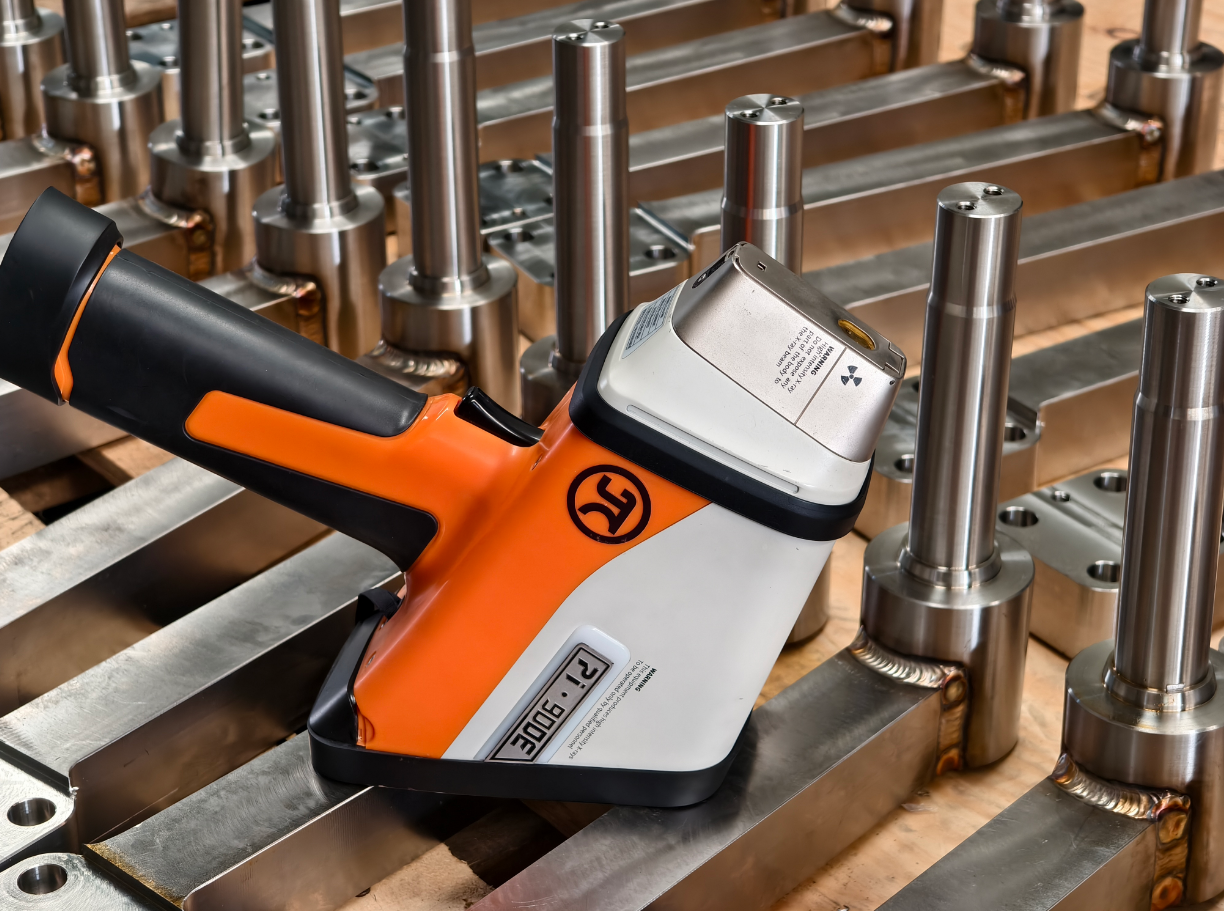
Terras Pi900E Handheld Precious Metal Analyzer
Conclusion: Making the Right Choice
Choosing your first portable handheld XRF analyzer is a balance of application need, performance, and budget.
Ensure the device is rugged enough for your environment and safe to use. Finally, consider the software—it should make your job easier, not harder.
About Terra Scientific
Terra Scientific is a high-tech manufacturer specializing in the development and application of X-ray technology products. We are committed to becoming a world-class provider of X-ray industrial inspection solutions. Terra Scientific currently offers a range of products to global customers, including handheld alloy analyzer, handheld precious metal analyzer, handheld mining analyzer, benchtop precious metal analyzers, in-line analyzer, and spectrometer modules, along with XRF analyzers. We continuously serve global clients in fields such as mechanical manufacturing, metal processing, aerospace, petrochemicals, mining and geology, food safety, environmental protection, and scientific research.
To learn more, please don't hesitate to contact us via email at sales@terra-scientific.com, or visit our website at http://www.terra-scientific.com
Join Us
Subscribe to our email list for updates & promotions.